

The biosynthesis and consumption of NAD+ (nicotinamide adenine dinucleotide, coenzyme I) are strictly regulated by the circadian rhythm, and it serves as a crucial link between metabolic state and the biological clock.
How does NAD+ affect sleep?
1. NAD+ and biological clock - a two-way closed loop
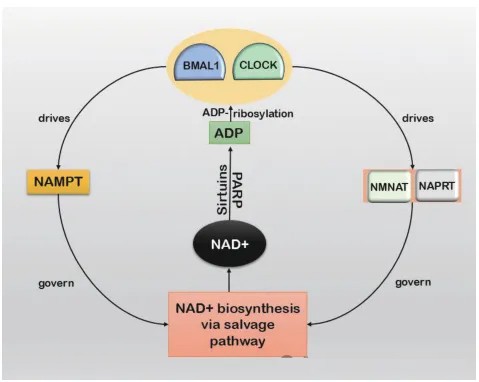
The relationship between NAD+ and the biological clock is not a one-way regulation, but rather a precise two-way feedback loop.
Studies have shown that NAMPT (nicotinamide phosphoribosyltransferase) is the rate-limiting enzyme in the NAD+ salvage pathway.
Its expression and activity exhibit circadian rhythm changes, thereby causing the circadian fluctuations in NAD+ levels.
Direction 1: The biological clock regulates the rhythm of NAD+:
The gene expression and enzymatic activity of NAMPT are directly regulated by the core circadian protein complex CLOCK/BMAL1, showing obvious diurnal rhythm changes.
The intracellular NAD+ level also undergoes periodic fluctuations.
During the day, the active period of NAD+ within the cells is relatively at its peak.
Direction 2: Reverse calibration of the biological clock using NAD+
As a necessary substrate for the proteins in the Sirtuins family, fluctuations in NAD+ levels affect the activity of SIRT1.
SIRT1 exerts negative feedback regulation on the transcription of circadian clock genes by deacetylating and inhibiting the activity of CLOCK/BMAL1.
This forms a complete cycle, explaining why disruptions to metabolism (such as irregular diet, staying up late, and low NAD+ levels due to aging) directly disrupt the sleep rhythm:
Biological clock gene (CLOCK/BMAL1) → Transcriptional activation → Increase in NAMPT expression → Increase in NAD+ synthesis and level → Activation of NAD+ → Increase in SIRT1 deacetylase activity → Deacetylation and inhibition by SIRT1 → Decrease in activity of biological clock gene (CLOCK/BMAL1) → …
Conversely, stabilizing this cycle through dietary means, regular rest, or supplementing with NAD+ is a fundamental strategy that helps to reinforce the stability of the biological clock at the molecular level, thereby improving the health of the sleep rhythm.
2. NAD+ maintains balance between energy and oxidative stress
High-quality sleep requires the brain and body cells to undergo non-essential consumption, prioritize the supply of mitochondria, and enhance metabolic efficiency during the "rest" period, in order to repair the necessary basic energy.
NAD+ maintains energy supply during sleep:
NAD+ is the core coenzyme in cellular energy metabolism.
It serves as an essential electron carrier for the key energy-producing processes of glycolysis, the tricarboxylic acid cycle, and oxidative phosphorylation, directly participating in the generation of ATP.
During the day/active period, NAD+ is extensively utilized in energy-consuming reactions such as DNA repair and immune inflammatory responses, which leads to the rapid depletion and breakdown of NAD+.
However, during sleep, physical activity, external damage and cognitive load drop to their lowest levels, significantly reducing NAD+ consumption.
During sleep, insulin sensitivity and mitochondrial function efficiency are enhanced, allowing NAD+ to produce energy more concentratedly and efficiently, and eliminating metabolic waste.
Regulation of NAD+ Antioxidant Defense:
(1) Directly participating in redox reactions:
NAD+ exists in cells in two forms: NAD+ (oxidized state) and NADH (reduced state). The mutual conversion between these two forms is the core of cellular redox reactions.
(2) Through the regulation of Sirtuins:
As a dependent enzyme for Sirtuins proteins, NAD+ (such as SIRT3) can deacetylate and activate antioxidant enzymes like SOD2, thereby directly enhancing the mitochondrial ability to remove reactive oxygen species and alleviating oxidative stress.
NAD+ can also activate the SIRT2-ERK-Nrf2 pathway, promoting the synthesis of endogenous antioxidant substances such as glutathione and enhancing the overall antioxidant capacity of the cells.
NAD+ ensures efficient energy recovery and oxidative damage repair during sleep through the biological clock feedback loop and the balance of energy and oxidation.
When the level of NAD+ is insufficient, these two mechanisms are unable to maintain the cell state, resulting in disrupted rhythms and a decline in sleep repair functions.
Evidence of influence of NAD+ on sleep
NAD+ improves sleep quality in older people population:
A randomized, double-blind controlled study conducted on healthy older people in Japan found that continuous supplementation with NAD+ precursors for 12 weeks resulted in improved sleep quality, shorter sleep onset time, and reduced daytime sleepiness.
NAD+ improves sleep efficiency in people with insomnia:
Clinical studies have shown that supplementing NAD+ enhances the performance of the clock genes BMAL1 and PER2.
In young and middle-aged male patients with insomnia, supplementing with NAD+ increased the REM sleep time of healthy subjects, and improved the sleep efficiency of those with moderate to severe insomnia.
The Korean Health and Nutrition Examination Survey (KNHASES) has found that abnormal sleep among premenopausal women is associated with widespread nutrient deficiencies, while the association pattern among postmenopausal women is more specific and is significantly influenced by alcohol consumption.
Is it because of insufficient NAD+ levels that you are experiencing insomnia?
Insufficient NAD+ levels are very likely to be a factor contributing to or exacerbating insomnia.
Factor One: Age Factor:
It is known that the level of NAD+ significantly decreases with age, which is consistent with the common phenomena observed in the older people, such as shallower sleep, easy awakening, and early waking.
For age-related sleep problems, insufficient NAD+ levels are likely to be one of the core physiological mechanisms.
Factor Two: Complex Causes:
The causes of insomnia are extremely complex, including psychological stress, anxiety and depression, bad sleep habits, and other diseases.
Recent studies have shown that the level of NAD+ decreases with age or under metabolic stress, leading to physiological conditions such as disrupted circadian rhythms, accumulation of oxidative stress, and decreased efficiency of energy metabolism.
When other factors present as well, it can exacerbate the symptoms of insomnia.
References:
- [1]. Abbas, Kashif & Sharf, Rushda & Alam, Mudassir & Sharf, Yusra & Usmani, Nazura. (2024). Chronotherapeutic and Epigenetic Regulation of Circadian Rhythms: Nicotinamide Adenine Dinucleotide-Sirtuin Axis. Journal of Sleep Medicine. 21. 127-133. 10.13078/jsm.240015.
- [2]. Taosheng Huang, The Role of NAD+ in Anti-Aging Therapies. Am J Biomed Sci & Res. 2019 - 6(5). AJBSR.MS.ID.001080. DOI:10.34297/AJBSR.2019.06.001080
- [3]. Navas LE, Carnero A. NAD+ metabolism, stemness, the immune response, and cancer. Signal Transduct Target Ther. 2021 Jan 1;6(1):2. doi: 10.1038/s41392-020-00354-w. PMID: 33384409; PMCID: PMC7775471.
- [4]. Masri S, Orozco-Solis R, Aguilar-Arnal L, Cervantes M, Sassone-Corsi P. Coupling circadian rhythms of metabolism and chromatin remodelling. Diabetes Obes Metab. 2015 Sep;17 Suppl 1(0 1):17-22. doi: 10.1111/dom.12509. PMID: 26332964; PMCID: PMC4732882.
- [5]. Zhang Jie. Research on the Effects and Mechanisms of NAD+ on Cellular Energy Metabolism and Antioxidant Capacity [D]. Shanghai Jiao Tong University, 2019.
- [6]. Kim M, Seol J, Sato T, Fukamizu Y, Sakurai T, Okura T. Effect of 12-Week Intake of Nicotinamide Mononucleotide on Sleep Quality, Fatigue, and Physical Performance in Older Japanese Adults: A Randomized, Double-Blind Placebo-Controlled Study. Nutrients. 2022 Feb 11;14(4):755. doi: 10.3390/nu14040755. PMID: 35215405; PMCID: PMC8877443.
- [7]. Robinson, C.R.; Pegram, G.V.; Hyde, P.R.; Beaton, J.M.; Smythies, J.R. The effects of nicotinamide upon sleep in humans. Biol. Psychiatry 1977, 12, 139–143.
- [8]. Nguyen, H.D. Higher intakes of nutrients and regular drinking are associated with habitual sleep duration in pre- and postmenopausal women with comorbidities. Sleep Health 2023, 9, 688–697.