As health and longevity have become popular topics, NAD+ (nicotinamide adenine dinucleotide) and its related substances have long been the "star molecules" in the field of anti-aging.
And the recent new developments in the regulatory policies regarding NMN have also attracted a lot of attention.
In-depth analysis:
Differences among the core members of the NAD+ family, the latest global regulatory developments, and the evolution direction of the product, all of which will be used to compile a comprehensive NAD+ scientific anti-aging guide for everyone.
core differences among members of NAD + family
NAD+ (Nicotinamide Adenine Dinucleotide)
NAD+ is a crucial coenzyme in the human body and also a signaling molecule.
Its core functions are involved in various vital physiological processes such as energy metabolism, DNA damage repair (dependent on PARP enzymes), gene expression regulation (dependent on sirtuins deacetylases), and cell aging regulation.
It serves as the "energy hub" and "repair switch" that maintains normal cellular functions and life activities.
1. NAD+ Synthesis Pathway
The synthesis of NAD+ in the human body mainly occurs through two pathways.
Synthetic path from the beginning:
Starting from tryptophan as the raw material, it is gradually transformed through the kynurenine pathway to produce nicotinic acid mononucleotide (NaMN), which is then further synthesized into NAD+.
This pathway is active in organs such as the liver, but its efficiency is relatively low and is greatly influenced by tryptophan intake and metabolic status.
Remedial synthesis path:
Using precursors such as nicotinamide (NAM), nicotinamide riboside (NR), and β-nicotinamide mononucleotide (NMN) as raw materials.
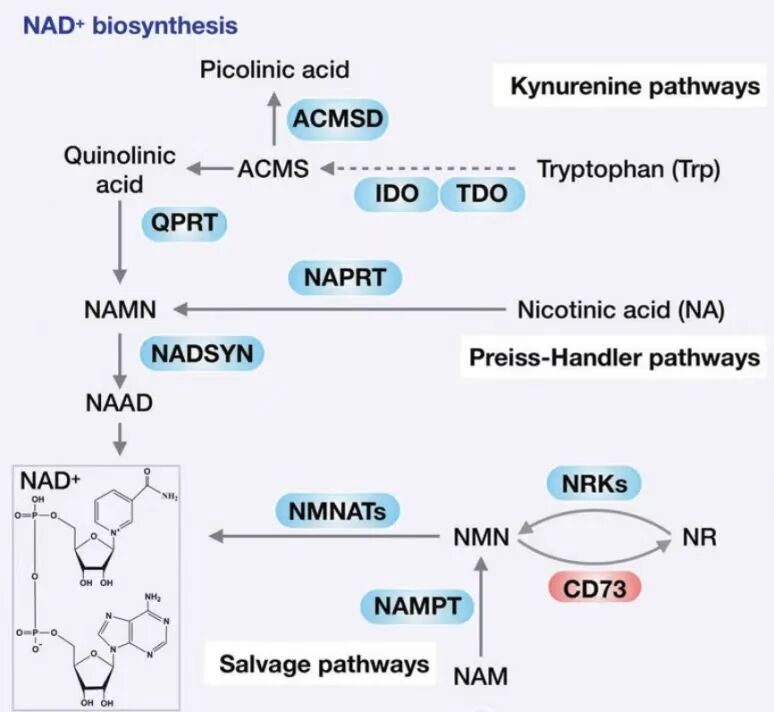
Among them, NAM is catalyzed into NMN by nicotinamide phosphoribosyltransferase (NAMPT, the key rate-limiting enzyme for salvage synthesis), and NMN is then catalyzed into NAD+ by nicotinamide mononucleotide adenylyltransferase (NMNAT).
NR and NMN can directly proceed to the downstream steps of this pathway, bypassing the NAMPT rate-limiting step, and are the main dependent pathways for exogenous supplementation of NAD+.
2. Characteristics of Absorption and Utilization
The intracellular NAD+ is mainly generated through the conversion of precursors (such as NMN, NR), and its level decreases with age (due to the decline in NAMPT activity and the increase in CD38 enzyme consumption), as well as with unhealthy lifestyles (such as staying up late and excessive drinking), and in the context of disease conditions.
The NAD+ molecule has a large molecular weight and carries a charge.
After oral administration, it is difficult to pass through the intestinal barrier and is easily decomposed by digestive enzymes into small molecular fragments such as nicotinamide.
The direct oral bioavailability is extremely low.
NADH (reduced form of NAD+)
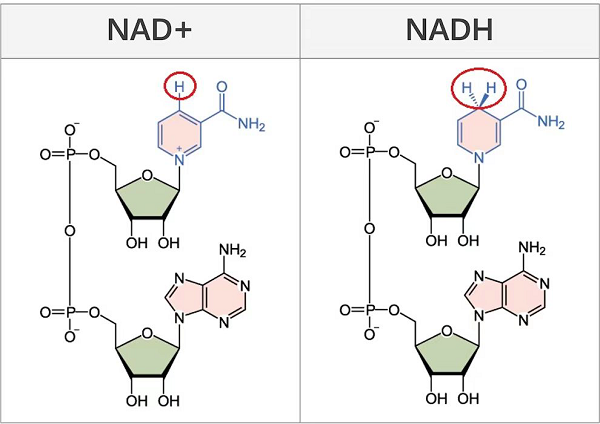
NADH is the reduced form of NAD+.
Its core function is to act as an electron carrier in energy metabolism.
It accepts hydrogen atoms and electrons in glycolysis and the tricarboxylic acid cycle, then transfers electrons through the mitochondrial respiratory chain and releases energy, subsequently converting back to NAD+.
1. conversion pathway of NADH
NADH is the direct energy-carrying precursor of NAD+.
Unlike other precursors (such as NMN and NR), which require the consumption of ATP for multiple steps of conversion to generate NAD+, NADH, during its conversion to NAD+, can contribute to ATP synthesis through the electron transport chain on its own.
The theoretical conversion path is shorter and more efficient.
Intracellular transformation:
During the process of energy metabolism, NAD+ accepts electrons and hydrogen atoms and is reduced to NADH. NADH then undergoes oxidative dehydrogenation through the respiratory chain and is re-generated as NAD+, forming the "NAD+-NADH" cycle, which maintains the continuous progress of energy metabolism.
Exogenous supplementation:
After oral intake of NADH, it needs to be dehydrogenated within the cells to convert into NAD+, and then participate in NAD+ dependent physiological processes.
Essentially, it exerts its effect indirectly by converting into NAD+.
2. Characteristics of Absorption and Utilization
NADH has poor stability and is easily decomposed by gastric acid and digestive enzymes (such as nucleases).
Its bioavailability after oral administration is low.
Currently, technologies such as microcapsule coating and liposome delivery can enhance the stability and absorption efficiency of NADH in the intestinal tract.
However, whether it can effectively penetrate the cell membranes (including those of brain cells) after entering the bloodstream still requires more research to support.
Furthermore, the efficiency of NADH converting to NAD+ is influenced by the energy demands of the cells and the activity of NADH dehydrogenase.
3. Relevant Studies
Clinical studies have shown that NADH supplementation can improve the fatigue scores of patients with chronic fatigue syndrome and has a certain auxiliary effect on the motor function of patients with Parkinson's disease.
NR (Nicotinamide Riboside)
NR is the direct precursor of NMN and belongs to the derivative of vitamin B3.
Its core advantages are a short conversion pathway and low toxicity.
It can bypass the rate-limiting enzyme (NAMPT) for NAD+ salvage synthesis and be directly catalyzed by nicotinamide riboside kinase (NRK1/2) within the cell to generate NMN, which can then be rapidly converted into NAD+.
It is one of the NAD+ supplementation precursors that are widely used in current clinical research.
1. Absorption and Utilization Characteristics
The NR molecule is small in size and neutral in nature. After oral administration, it can quickly pass through the intestinal barrier.
After entering the bloodstream, it is mainly absorbed by organs such as the liver, kidneys, and brain.
Inside the cells, it is efficiently converted into NMN by the enzyme NRK (the activity of this enzyme is not significantly inhibited by age or disease), and this conversion process is relatively efficient.
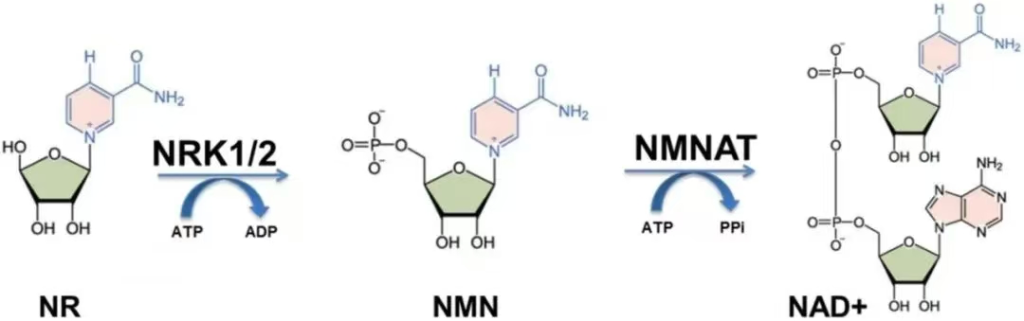
It has been confirmed that NR can increase the level of NAD+ in the central nervous system.
2. Related research
Multiple trials have shown that when healthy adults take 100-1000mg of NR orally daily, their blood NAD+ levels significantly increase, and no obvious adverse reactions were observed after short-term supplementation.
A randomized, double-blind, controlled phase II clinical trial demonstrated that for Parkinson's disease patients, daily supplementation with NR over a period of time not only significantly increased the total NAD level in the brain, but also improved brain energy metabolism, reduced inflammatory markers, and showed a trend of improvement in motor function.
Studies have shown that NR has a positive effect on patients with chronic obstructive pulmonary disease (COPD).
After 6 weeks of supplementation, the levels of NAD+ in the patients' blood increased, and the inflammatory factors decreased.
A clinical study on Waardenburg syndrome published in "Aging Cell" in June 2025 has attracted widespread attention.
Waardenburg syndrome is caused by mutations that impair DNA repair, resulting in cells aging decades earlier than normal.
This newly published double-blind, placebo-controlled study found that daily supplementation with NR significantly increased the blood DID+ level in patients with WS by approximately 140%, improved the degree of arterial stiffness (an indicator of cardiovascular disease risk), reduced the area of skin ulcers, and seemed to slow down the progression of renal dysfunction.
NMN (β-Nicotinamide Mononucleotide)
NMN is the key direct precursor for the synthesis of NAD+.
Its core advantage lies in the fact that it only requires one reaction (mediated by NMNAT) to be converted into NAD+, with high conversion efficiency.
Moreover, it is a naturally occurring substance in the human body, has good biocompatibility, and is currently one of the most popular precursors in the field of NAD+ supplementation.
1. synthesis pathway of NMN
Intracellular synthesis:
Endogenous NMN is mainly generated through two pathways:
One is that nicotinamide (NAM) is generated under the catalysis of the rate-limiting enzyme NAMPT.
The second one is generated by NR being catalyzed by NRK kinase.
As age increases, the decline in NAMPT activity is one of the key factors leading to the depletion of NAD+ levels in the body.
Exogenous supplementation and absorption re-examined:
A study published in Science Advances in 2025 revealed that the vast majority (approximately 90%) of orally ingested NMN is not directly absorbed but instead, after entering the colon, is metabolized by the gut microbiota into smaller molecules such as nicotinic acid (NA).
These metabolites then undergo the enterohepatic circulation and are efficiently synthesized into NAD+ through the Preiss-Handler pathway in the liver, which subsequently distributes throughout the body.
The sterile mouse experiment revealed that the integrity of the intestinal microbiota might be a necessary condition for NMN to increase the level of NAD+ in the body.
This indicates that the differences in individual gut health may be a key variable influencing the effectiveness of NMN supplementation.
Related research
The team led by Professor Qu Leifeng from the Second Affiliated Hospital of Naval Medical University (Shanghai Changzheng Hospital) successfully completed China's first anti-aging NMN human clinical trial conducted in a tertiary hospital, marking the official entry of research in this field into a new stage of clinical evidence-based research.
The research results show that, compared with the placebo group, the levels of the aging-related metabolites downstream of NMN in the blood of the subjects taking NMN were significantly higher.
More importantly, when NAD-capped RNA was used as the "biological age clock" for measurement, the biological age of the NMN group showed a significant reduction.
In addition to objective indicators, the study also recorded the improvement in the subjects' subjective feelings, such as 70% of the subjects reporting a reduction in daily fatigue, 60% of the subjects experiencing a decrease in their daily blood pressure monitoring levels, and 55% of the subjects feeling an improvement in their motor function, demonstrating the potential value of NMN in improving the overall quality of life.
Latest compliance updates for members of NAD + family
NAD+
Currently, globally, NAD+ does not have a formal regulatory framework and is classified as a "regulatory grey area".
For instance, regulatory agencies in major regions such as the US FDA, the EU EFSA, and Japan's MHLW have not approved it as a dietary supplement or a food ingredient.
Most of the NAD+ products currently available on the market are operating at the "non-compliant edge", without a clear legal identity to back them up. When purchasing, be aware of the risks.
NADH
The regulatory situation of NADH is largely similar to that of NAD+:
there is no unified global regulatory standard, and it has not received official approval from major regional regulatory authorities.
Currently, no region has updated special regulatory policies for NADH. It remains in an "unclassified" status.
Whether the product can be circulated mainly depends on the leniency of local regulations. The compliance risk is relatively high.
NR
NR is the most securely certified precursor in the NAD + family. Apart from China, its legal status has been clearly defined in most regions.
Europe and America:
Both the European Food Safety Authority (EFSA) and the US Food and Drug Administration (FDA) have recognized NR as a qualified raw material for dietary supplements.
Therefore, enterprises can legally produce and sell them.
China: Currently, NR has not been approved as a raw material for food or health food.
Other regions: For instance, in Canada, NR has been included in the Natural Health Products (NHP) registration system.
Companies only need to complete the registration in accordance with the standards and can then sell their products normally.
NMN
(2025: A Critical Turning Point in Regulation)
NMN is the component with the greatest regulatory differences.
In 2025, key adjustments were made to policies in multiple countries and regions, shifting from the previous "ban or ambiguous state" to "gradual clarification". Here, we will provide a detailed overview:
The United States: From "Ban" to "Reinstatement of Legality"
In 2022, the US FDA prohibited the sale of NMN as a dietary supplement due to the "drug exclusion clause" (considering it as a potential drug).
However, in September 2025, the FDA officially revoked this "new drug approval" and restored the legal status of NMN as a dietary supplement.
The main reason is that the industry association (NPA) provided evidence showing that NMN had been sold as a dietary supplement in 2017, earlier than the related new drug research, which complies with the "prior to drug sales" principle for dietary supplements.
At present, the e-commerce platforms in the United States have gradually resumed the listing of NMN products.
EU: Initiates "New-Type Food" Safety Assessment
In July 2025, the EFSA (European Food Safety Authority) of the European Union officially launched the safety assessment of NMN as a "new type of food".
At present, some Chinese enterprises have submitted their applications and have entered the risk assessment stage.
According to the EU's process, the assessment results are expected to be announced in 2026.
Japan: Maintains "General Food Raw Materials" positioning
As early as 2020, the Ministry of Health, Labour and Welfare of Japan had already recognized NMN as a "common food raw material".
There were no new restrictions in 2025, and enterprises could carry out normal production and sales. The NMN products in the Japanese market were also quite diverse.
China: Approves "Food Additives"
In January 2025, the National Health Commission of China included NMN in the list of "new food additive varieties" for review, but the final outcome has not been announced yet.
Literature research
- [1]Chen Ziyi, Wang Hongyang, Wang Qiuju. The therapeutic potential of NADH: Neurodegenerative diseases characterized by mitochondrial dysfunction [J]. Journal of Clinical Otorhinolaryngology Head and Neck Surgery, 2024, 38(1): 57-62. DOI: 10.13201/j.issn.2096-7993.2024.01.009.
- [2]Berven H, Kverneng S, Sheard E, et al. NR-SAFE: a randomized, double-blind safety trial of high dose nicotinamide riboside in Parkinson’s disease[J]. Nature Communications, 2023, 14: 7793.
- [3]Norheim KL, Ben Ezra M, Heckenbach I, et al. Effect of nicotinamide riboside on airway inflammation in COPD: a randomized, placebo-controlled trial[J]. Nature Aging, 2024, 4: 1772-1781.
- [4]Shoji M, Kato H, Koshizaka M, et al. Nicotinamide Riboside Supplementation Benefits in Patients With Werner Syndrome: A Double-Blind Randomized Crossover Placebo-Controlled Trial. Aging Cell. 2025 Aug; 24(8):e70093. doi: 10.1111/acel.70093.
- [5]Yaku K, Palikhe S, Iqbal T, et al. Nicotinamide riboside and nicotinamide mononucleotide facilitate NAD⁺ synthesis via enterohepatic circulation[J]. Science Advances, 2025, 11(12): eadr1538.