

In Brian Johnson's anti-aging checklist, NAD+ supplements are prominently listed.
Three generations of his family underwent blood transfusions, took hundreds of dietary supplements every day, underwent gene editing, and had fat injections…
In order to achieve "immortality", American billionaire Brian Johnson spent an astonishing 2 million US dollars (approximately 14.33 million yuan) every year, not hesitating to try all kinds of extreme anti-aging methods.
According to public reports, at the age of 48 this year, he has successfully reversed his biological age by 5.1 years, reducing the aging rate to a new low of 0.48.
This is equivalent to aging only one year in two years (note: the benchmark value for the aging rate of ordinary people is 1.0, meaning "one year passes, one year older").
Are you also curious as to why some celebrities looked like this when we were young, but as we grow older and wrinkles start to appear on our faces, giving us a worn-out look, they still maintain their original appearance?
Do you also think that they rely on those extremely expensive skin care products?
In fact, it's not like that.
What truly keeps them looking youthful and firm even in their sixties and seventies is something that ordinary people can't see - it's the "cellular fuel" that we often refer to as NAD+.
NAD+ is an important coenzyme involved in the cellular energy cycle;
It is the DNA repairer and also the guide of the mitochondria. However, as one ages, the content of NAD+ in the human body continues to decline.
After the age of 30: The level of NAD+ drops by 50% every 10 years.
After the age of 40:
The activity of SIRT1 significantly decreases, and the process of cellular aging accelerates accordingly.
Once cells lack sufficient energy, their self-repairing ability will continue to decline, and various aging problems will follow one after another.
NAD+ anti-aging products are only popular among the wealthy circle and are a niche, high-end form of health preservation.
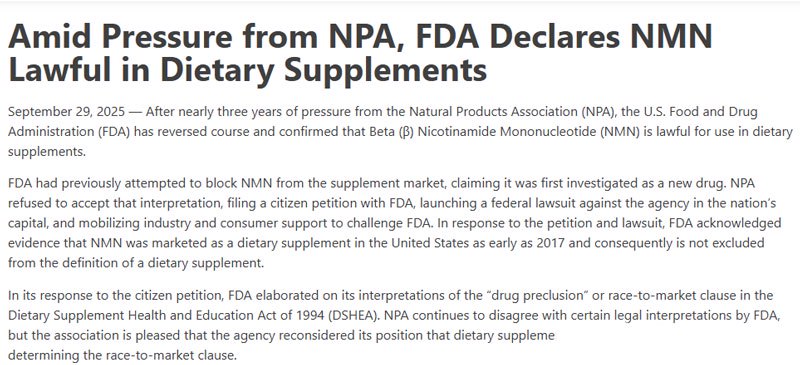
Until September 2025, after being officially certified and approved by the US FDA, NAD+ successfully broke through the barriers of different circles and officially entered the era of universal access to technological anti-aging.
In April 2026, the first "Chinese Expert Consensus on the Role of NAD⁺ in Aging-related Diseases and Its Clinical Applications (2026 Edition)" was officially released in China!
This national consensus, led by the Geriatrics Branch of the Chinese Medical Association and jointly formulated by authoritative experts in the fields of geriatrics, metabolic diseases, cardiovascular diseases, and neurology across the country, for the first time clearly defined the clinical application guidelines for NAD⁺ and its precursors (such as NMN, NR, etc.), including the applicable population, dosage plans, safety assessment, and efficacy monitoring standards.
It provides operational guidelines for grassroots medical institutions.
Key points of the expert consensus: The depletion of NAD+ is the root cause of human aging and the outbreak of chronic diseases.
This latest national-level authoritative consensus in 2026 clearly presents several important conclusions:
As people age, the levels of NAD⁺ in various parts of the body, such as the brain, heart, liver, and skeletal muscles, significantly decrease by 10% to 50%. This is a common feature of aging across species.
Insufficient NAD⁺ levels in the body can directly trigger a wide range of diseases, including metabolic disorders, cardiovascular diseases, neurodegenerative diseases, sarcopenia, and tumors, which are almost all common problems among the older people.
Scientific supplementation of NAD⁺ can regulate human metabolism, maintain the health of the heart muscle, delay muscle loss, assist in reducing physical damage caused by tumor chemotherapy, and improve nerve function.
Moreover, the overall safety of its use is high, with few side effects and easy to manage.
To delay aging and avoid chronic diseases in middle age and old age, the primary key lies in maintaining a stable level of NAD⁺ in the body's cells.