

Abstract
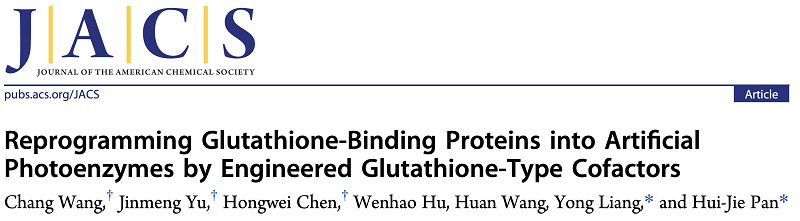
The photozyme catalysis combines the capabilities of photochemical activation and the chiral cavity regulation of enzymes, providing a completely new solution for the stereoscopic control of excited-state reactions.
The current construction strategies for artificial photosensors mainly include non-natural amino acid gene encoding, covalent connection of photosensitizers, and supramolecular anchoring.
However, these methods generally have shortcomings such as complex operation, insufficient modularity, and limited adaptational protein scaffolds.
In response to this issue, the Pan Huijie research group previously proposed the "co-factor engineering strategy":
The nicotinamide functional unit of NAD+ coenzyme was replaced with a benzophenone photosensitizer, and the NAD-type artificial cofactor BpAD was developed.
Through the natural coenzyme-protein interaction, multiple NAD-binding proteins could be directly reprogrammed into artificial phototransferases, achieving enantioselective [2+2] cycloaddition (Nat. Catal., 2025, 8, 822); the subsequent modification of MeO-BpAD further enabled intermolecular [2π+2σ] cycloaddition reactions (J. Am. Chem. Soc., 2026, 148, 13755).
To verify the universality of this design principle, the team expanded the research scope from classical coenzymes to the natural cofactor - glutathione (GSH).
Glutathione is widely present in living organisms. The corresponding glutathione S-transferase (GST) protein family has numerous members with diverse structures, making it an ideal scaffold library for constructing artificial enzymes.
Content
Recently, the team of Pan Huijie and Liang Yong from Nanjing University reported a new type of glutathione-based artificial light cofactor system:
By chemically modifying glutathione and introducing a benzophenone photosensitizing unit, a photoreactive cofactor GS-Bp1 was obtained.
This cofactor can mimic the binding pattern of natural GSH and assemble with various GST proteins through weak, reversible and specific interactions, directly reprogramming the natural glutathione-binding protein into an artificial photolyase.
Based on this system, the team successfully achieved intramolecular enantioselective [2+2] cycloaddition of sulfonamide substrates, efficiently constructing a chiral bicyclic sulfonamide framework.
Through protein screening and directed evolution, the human-derived GST A1-1 mutant can catalyze the synthesis of a series of bicyclic sulfonamide products, with yields ranging from moderate to excellent.
The enantioselectivity can reach up to 99% ee, the turnover number (TON) can be as high as 480, and the catalytic efficiency is more than two orders of magnitude higher than that of small molecule benzophenone catalysts.
Combining spectral characterization with molecular dynamics simulations, the study confirmed that directed evolution precisely regulated the stereoselectivity of the reaction by rebalancing the π-π stacking and dispersion interactions in the transition state.
This work expanded the cofactor engineering strategy from NAD+ coenzyme to glutathione-based molecules, establishing a universal platform for the construction of artificial enzymes.
Reaction development and optimization
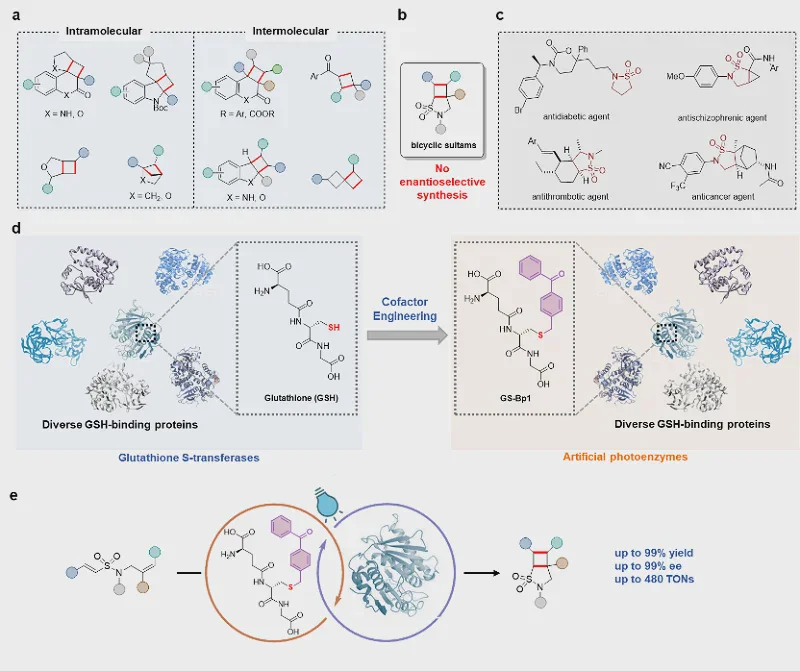
The team used the intramolecular [2+2] cycloaddition reaction of 2-aryl sulfonamide substrates as a model reaction, aiming to construct the chiral bicyclic sulfonamide framework.
The research design synthesized two glutathione-derived photosensitizers:
The GS-Bp1 containing the classic benzophenone unit, as well as the red-shift analog GS-Bp2 with amide substituents, can both be prepared through simple chemical modifications, demonstrating the modular advantage of the GS cofactor platform.
The blank control experiment indicates:
When no cofactors or proteins are present, the reaction does not occur at all;
only when free GS-Bp1/GS-Bp2 are added does there exist a slight activity, and there is no enantioselectivity.
This proves that the protein backbone is the core for catalytic activity and stereoscopic control.
Subsequently, the team screened various sources of GST family proteins. The results showed:
1. The combination of GS-Bp1 with human hGST A1-1 has the best performance, achieving a yield of 38% and an ee of 67% under the initial conditions.
2. Different protein-facoltide pairs can exhibit distinct enantiomeric preferences, demonstrating that this system can regulate stereoelectronic outcomes through the combination of components.
3. The isolated hGST A1-1 has no catalytic activity, which further confirms the necessity of the photoreactive cofactor.
The study analyzed the binding mode of GS-Bp1 in the hGST A1-1 active pocket through molecular dynamics (MD) simulations:
The partial structure of glutathione is highly consistent with the natural GSH binding pattern, retaining the hydrogen bonds with residues such as T74 and R51.
The benzophenone unit occupies the substrate binding pocket and forms π-π interaction with F226.
Based on this structural model, the team identified the key sites (L113, V117, L219, F226, etc.) close to the photosensitive unit within the active pocket and carried out directed evolution modifications:
1. Single-point mutation L113V: The enantioselectivity was enhanced from 67% ee to 85% ee;
2. Introduction of the second site V117I: The yield increased from 32% to 49%, and the enantiomeric excess (ee) further rose to 89%.
3. The third mutation L219I: The yield increased by 51%, and the ee rose to 92%.
Based on this, the team systematically optimized the reaction parameters such as the buffering system, pH value, solvent ratio, and light intensity.
Under the optimal conditions, the separation yield of model product 2a can reach 90%, and the enantiomeric ratio (ee) is 97%.
When the amount of artificial enzymes was reduced to 0.5 mol%, a yield of 62% and an enantiomeric excess of 96% were still maintained, demonstrating excellent catalytic turnover capability.
Evaluation of substrate universality
Under the optimal mutant and reaction conditions, the team conducted a comprehensive investigation of the substrate's applicable range:
1. Aromatic ring substituents:
It shows good tolerance to electron-donating substituents such as alkyl and alkoxy groups, and large steric hindrance groups like tert-butyl only slightly reduce the yield without affecting the enantioselectivity.
The substitution with electron-withdrawing halogens will lead to a decrease in yield, but the ee value remains basically unchanged.
Moreover, the larger the radius of the halogen atom, the more significant the negative impact will be.
The substitution at the meta-position and the ortho-position follows similar patterns.
2. Expansion of ring size:
When the sulfonamide ring expands from a five-membered ring to a six-membered ring, the reaction can proceed smoothly, and the ee value of the product reaches as high as 98%.
Further expansion to a seven-member ring results in complete inactivation.
3. Coumarin substrate:
When heterocyclic rings such as pyrazole, thiophene, and furan replace the benzene ring, the reactions can all proceed efficiently.
The enantiomeric selectivity is generally higher than 90%, and the ee value of some substrates can reach 99%.
4. Functional group influence:
The NH group of the sulfonamide is crucial for catalysis.
After alkylation modification, both the yield and the enantiomeric excess (ee) significantly decreased.
The additional substituents at the end of the alkenes will also significantly reduce the reaction performance due to steric hindrance effects.
Compared with the catalytic system of small molecule benzophenone, the reaction rate of this artificial photolyase reaction has increased by more than two orders of magnitude:
The small molecule system usually requires a loading of more than 10 mol% and a reaction time of over 96 hours.
However, the artificial enzyme system can achieve a high conversion rate within 3 hours, with a maximum conversion number (TON) of up to 480.
Mechanism research and selective origin
To uncover the catalytic mechanism and the source of stereoselectivity, the team conducted multi-dimensional experiments and computational studies:
1. Combined with affinity characterization:
The isothermal titration calorimetry (ITC) test revealed that the binding affinity of GS-Bp1/GS-Bp2 to GST protein was much stronger than that of natural glutathione, with a Kd value reaching the micromolar level, which was comparable to the binding strength of the natural coenzyme-protein complex.
This enhancement stems from the additional π-π stacking and dispersion interactions introduced by the diphenylmethane units.
2. Research on excited-state dynamics:
The transient absorption spectrum indicates that the excited state of the free GS-Bp1 is significantly quenched by oxygen (the lifetime is shortened from 12.7 μs to 2.4 μs).
After the protein assembly, the oxygen quenching effect significantly weakened, which proved that the protein cavity played a protective role for the excited state, and was consistent with the experimental result that oxygen did not affect the reaction efficiency and selectivity.
3. Verification of Reaction Kinetics:
The time-course experiment demonstrated that the free cofactor was almost inactive, but the reaction rate significantly increased after the protein was assembled.
Changing the molar ratio of the protein and its cofactor can regulate the reaction rate, but does not alter the enantioselectivity.
This proves that both the catalytic activity and the stereospecificity originate from the protein-cofactor assembly.
4. Three-dimensional Selective Origin:
DFT calculations confirmed that the bonding of C1-C4 is the rate-determining step of the reaction. MD simulations and combined free energy analysis indicated:
Among the wild-type enzymes, the TS-S configuration is more stable due to the stronger π-π stacking effect.
However, the dispersion effect will preferentially stabilize the TS-R configuration, partially offsetting the advantage of π-π stacking. As a result, the ee value is moderate.
The targeted evolutionary mutations selectively weaken the stabilizing dispersion effect of the TS-R, rebalance the two non-covalent interactions, gradually expand the energy advantage of TS-S, and ultimately achieve an enantiomeric selectivity of up to 99%.