

Amino acids are crucial in the initiation, progression and resistance of tumors.
The limited supply of amino acids in the tumor microenvironment restricts their acquisition, and this has become a promising anti-tumor strategy.
Cysteine has attracted much attention due to its involvement in multiple functions such as protein synthesis, generation of antioxidant molecules (such as glutathione), metabolism of cofactors, and assembly of iron-sulfur clusters in mitochondria.
The classic view holds that the intracellular cysteine pool of tumors is mainly maintained through three pathways:
The ASCT1 transporter takes up, the xc⁻ system (xCT/CD98) mediates the uptake of cystine, which is reduced by TXNRD1, and it is also synthesized anew from methionine through the transsulfuration pathway.
Among these, the xc⁻ system is regarded as the dominant source.
However, the Slc7a11 knockout mice were still able to survive, and the sulfur transduction pathway was in an inhibited state in most tumors, suggesting that there might be an as-yet-unrecognized alternative mechanism for obtaining cysteine in tumors.
Glutathione (GSH) is composed of glutamic acid, cysteine and glycine.
It has long been regarded as an intracellular antioxidant, involved in the regulation of oxidative stress and drug detoxification, and has a tumor-promoting effect.
However, the mechanism of its action remains unclear.
It is worth noting that extracellular glutathione can be decomposed and utilized:
The rate-limiting degradation is catalyzed by γ-glutamyl transferase (GGTs), which generates glutamate and cysteinyl glycine.
The latter is then hydrolyzed by peptidase to release cysteine.
Early studies have confirmed that extracellular glutathione can support cell growth under cysteine deficiency conditions.
The Ggt1-deficient mice exhibit decreased tissue cysteine levels and perinatal lethality.
Similarly, patients with clinical GGT1 mutations also present with glutathione deficiency and decreased circulating cystine.
The above evidence collectively suggests that the glutathione degradation metabolism mediated by GGTs may be an important pathway for the body to obtain cysteine.
However, whether tumor cells can "hijack" this process to support their own growth remains to be systematically explained, which constitutes the core scientific issue of this study.
Recently, the research team led by Isaac S. Harris and Fabio Hecht from the Department of Biomedical Genetics at the University of Rochester Medical Center in New York State published a research paper titled "Catabolism of extracellular glutathione supplies cysteine to support tumours" in Nature.
The study found that the intracellular glutathione synthesized by the tumour itself is not essential for its growth.
What is truly crucial is the highly enriched extracellular glutathione in the tumour microenvironment - as a "cysteine reservoir", it is catalyzed by γ-glutamyl transferase (GGTs) to break down and continuously supply cysteine to the tumour cells, thereby supporting their survival and proliferation, and enabling them to develop resistance to anti-tumour drugs that target cysteine uptake.
This work not only reveals a previously overlooked pathway for tumor amino acid acquisition, but also redefines the role of glutathione in tumor metabolism, providing a completely new target for intervention in cancer nutrition deprivation therapy.
endogenous glutathione synthesis within tumor is not essential for its growth.
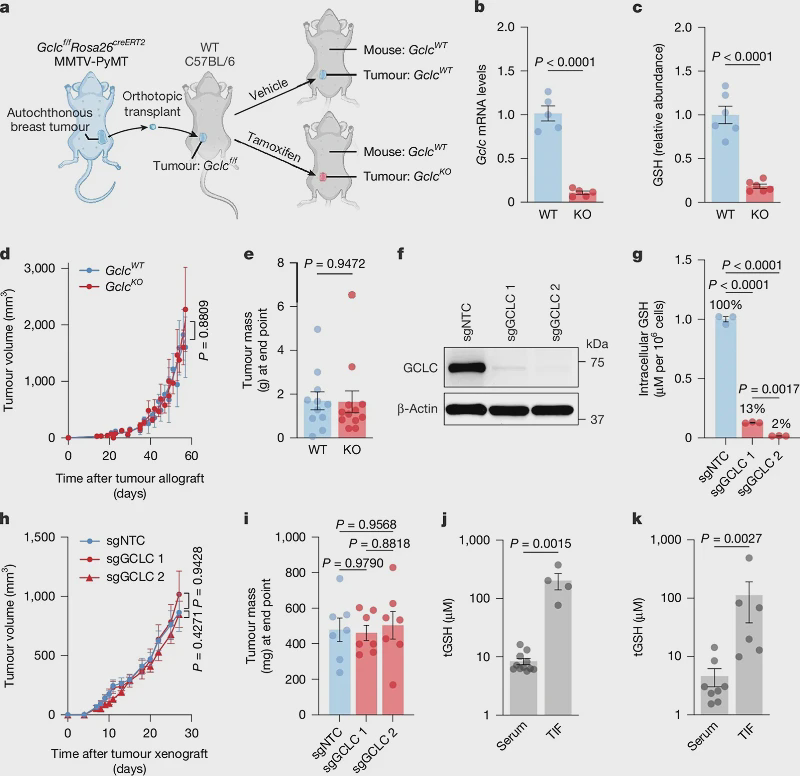
To investigate whether endogenous glutathione synthesis within tumors is essential for tumor growth, the authors crossed MMTV-PyMT transgenic mice that spontaneously develop breast tumors with Gclcf/fRosa26creERT2 mice carrying the conditional knockout allele of Gclc.
This resulted in the construction of a mouse model that can be induced to knockout the rate-limiting enzyme GCLC for glutathione synthesis using tamoxifen.
The author removed the spontaneous tumors and transplanted them in situ into immunocompetent wild-type C57BL/6 recipient mice.
Tumor-specific Gclc knockout was achieved through tamoxifen treatment (Figure 1A).
The results showed that the levels of Gclc mRNA and glutathione in the tumor tissues were significantly decreased (Figures 1B and 1C), but glutathione was not completely eliminated, suggesting that there were non-tumor cells expressing GCLC in the tumor microenvironment.
It is worth noting that the Gclc knockout did not affect tumor growth (Figures 1D and E), nor did it trigger compensatory metabolic changes such as oxidative stress or cysteine accumulation, indicating that the tumor's own ability to synthesize glutathione is not essential for its growth.
In the subcutaneous transplantation model, the authors observed consistent phenotypes, and reached the same conclusion after completely depleting glutathione in human breast cancer HCC-1806 cells through GCLC knockout (Figures 1F–I).
Given that the absence of intracellular glutathione does not affect tumor growth, the authors hypothesized that extracellular glutathione might be the key source supporting tumor growth.
To verify this hypothesis, the authors measured the levels of total glutathione (tGSH, defined as the sum of reduced glutathione and twice the oxidized form of glutathione, GSSG) in serum and tumor stromal fluid (TIF, the extracellular microenvironment surrounding the tumor).
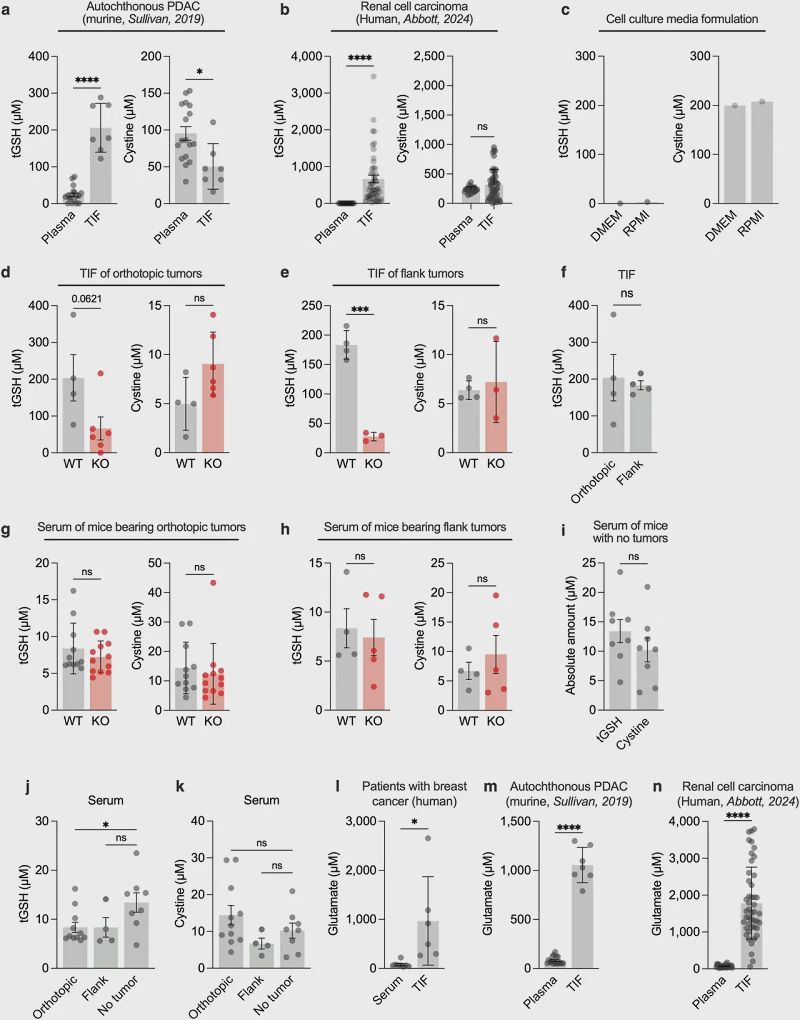
The results showed that the content of tGSH in the TIF of mouse and human breast tumors was significantly higher than that in the serum (Figures 1J, K), and this pattern was also confirmed in the mouse model of pancreatic ductal adenocarcinoma (PDAC) and in human renal cell carcinoma (Supplementary Figures 3A, B).
The concentration of tGSH in the TIF was even higher than the added amount in the conventional cell culture medium (Figure 3C).
Further comparison of TIF between WT and Gclc knockout tumors revealed that the glutathione synthesis within the tumors contributed only partially to the tGSH in TIF, while it had almost no effect on serum tGSH (Supplementary Figure 3D–H).
In tumor-free mice, there was no significant difference in serum tGSH and cystine levels (Supplementary Figure 3I), while the serum tGSH (but not cystine) levels in tumor-bearing mice were significantly lower than those in tumor-free mice (Supplementary Figures 3J and K).
The author demonstrated that the synthesis of intracellular glutathione in tumor cells is not essential for their growth and survival, while extracellular glutathione is highly concentrated and may provide support for tumor growth.
Regardless of whether the synthesis of glutathione is blocked or not, the tumor can always obtain sufficient upstream metabolic substrates (namely cysteine) to sustain its growth.
Extracellular glutathione provides cysteine to tumors.
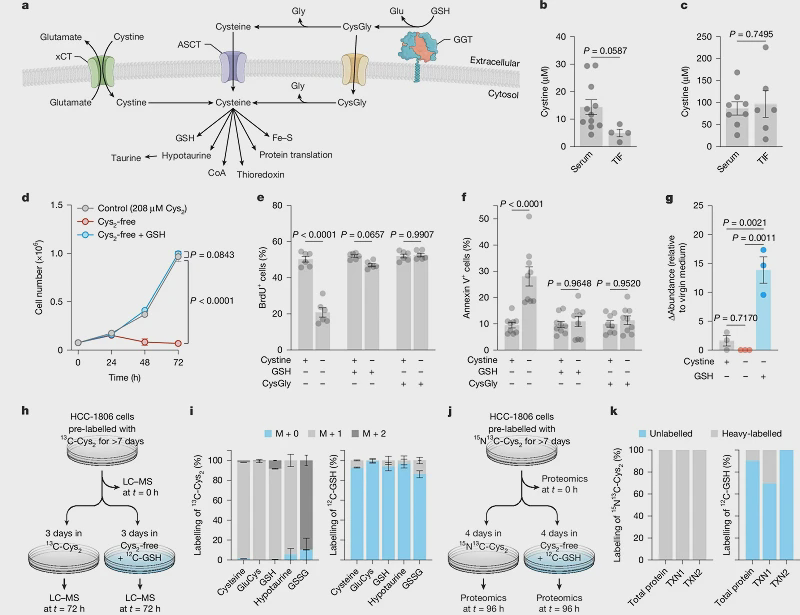
The conventional view holds that the uptake of cysteine mediated by the cystine-glutamate antiporter xCT is the primary way for tumors to obtain cysteine (Figure 2A).
By comparing the metabolite profiles of TIF and serum, the author discovered that glutamate, which can competitively inhibit xCT activity, was significantly enriched in TIF (Supplementary Figure 3L–N), while the level of cysteine showed no difference (Figures 2B and C), suggesting that cysteine may not be the main source of cysteine in the tumor microenvironment.
Given that GSH, as a tripeptide containing cysteine, can be hydrolyzed by GGT enzyme into cysteinyl glycine (CysGly) and glutamic acid, and CysGly can further be dehydrated to release intracellular cysteine, the authors hypothesized that GSH or its decomposition product CysGly might replace cysteine as a source of cysteine for tumors.
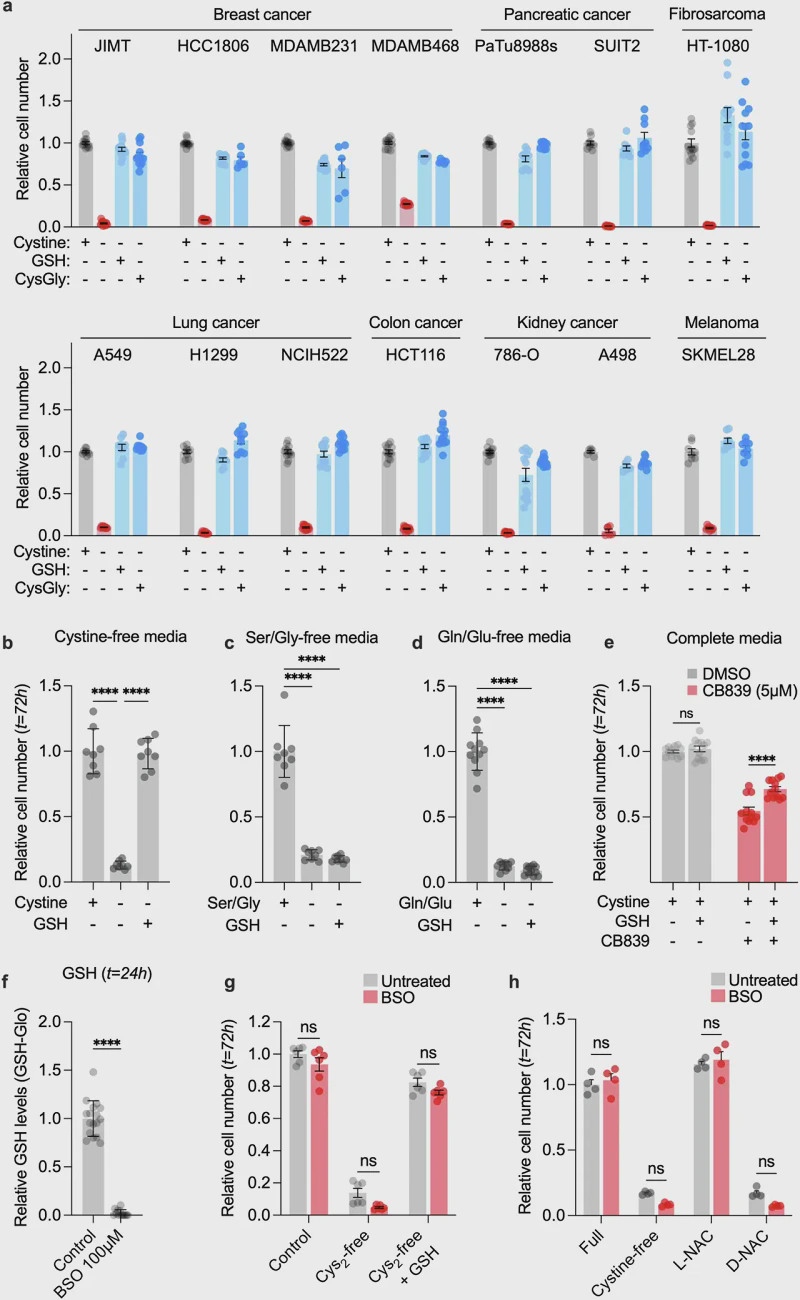
The results showed that supplementing with GSH or CysGly at the TIF physiological concentration could restore the growth of cancer cells in the cystine-free culture conditions (Figure 2D), and simultaneously rescue their survival and proliferation capabilities (Figure 2E, F).
To further verify the specificity and mechanism of this effect, the authors conducted a series of control experiments.
When other amino acids (serine, glycine, glutamine or glutamate) were removed or treated with the glutaminease inhibitor CB-839, glutathione was unable to achieve the rescue effect, suggesting that its action is specific to cysteine (Supplementary Figure 4B–E).
The pharmacological blockade of intracellular glutathione re-synthesis did not affect the rescue effect of glutathione under conditions without cysteine (Supplementary Figure 4F, G).
Moreover, L-type N-acetylcysteine (L-NAC), which has both the functions of providing cysteine and antioxidant activity, could rescue cell growth, while D-NAC, which only has antioxidant activity, was ineffective (Supplementary Figure 4H).
Considering that the absence of cysteine can trigger ferroptosis, the authors further discovered that the free radical scavenger ferrostatin-1 and trolox could only save cell survival but not restore proliferation.
This phenomenon held true in both ferroptosis-sensitive and -resistant cell lines, indicating that simply inhibiting lipid peroxidation is not sufficient to maintain tumor cells; a substantial supply of cysteine is also necessary.
To obtain direct evidence of the breakdown and utilization of glutathione, the authors compared the levels of metabolites under three conditions: control, without cysteine, and without cysteine but with glutathione.
The results showed that glutathione supplementation could time-dependently increase the accumulation of extracellular CysGly (Figure 2G), confirming that cancer cells have catabolic activity towards extracellular glutathione.
Although the intracellular CysGly and cysteine levels did not show significant recovery after glutathione supplementation, the authors found that reducing the cysteine concentration in the culture medium did not affect cell growth, but it could cause depletion of intracellular cysteine/cystine, and glutathione supplementation could rescue the levels of downstream cysteine products and inhibit the accumulation of cystine-derived cystine acid when cysteine was deficient.
To investigate whether the cysteine derived from glutathione actually enters the downstream metabolic and protein synthesis pathways, the authors employed a reverse stable isotope tracing strategy:
First, the cancer cells were labeled with 13C-cystine, and then they were switched to a medium without cystine but containing unlabeled glutathione (Figure 2H).
The results showed that cysteine and its downstream metabolites (glutamylcysteine, glutathione, and taurine) all changed from the labeled state to the unlabeled state after the switch (Figure 2I).
The experimental study using 15N13C-cysteine combined with high-resolution proteomics further verified the above conclusion (Figures 2J and K), and the proportion of residual labels on each peptide segment was positively correlated with the protein half-life.
Given that the intracellular glutathione synthesis in tumor cells contributes to the tGSH in TIF, the authors pharmacologically inhibited the glutathione efflux transporter in breast cancer cells and found that although it promoted the accumulation of intracellular glutathione, it did not affect the rescue effect of glutathione under conditions without cysteine.
The author demonstrated that extracellular glutathione can be decomposed and utilized by cancer cells, providing cysteine for their intracellular metabolism and protein synthesis processes.
GGT1 drives breakdown of glutathione and supports cell survival.
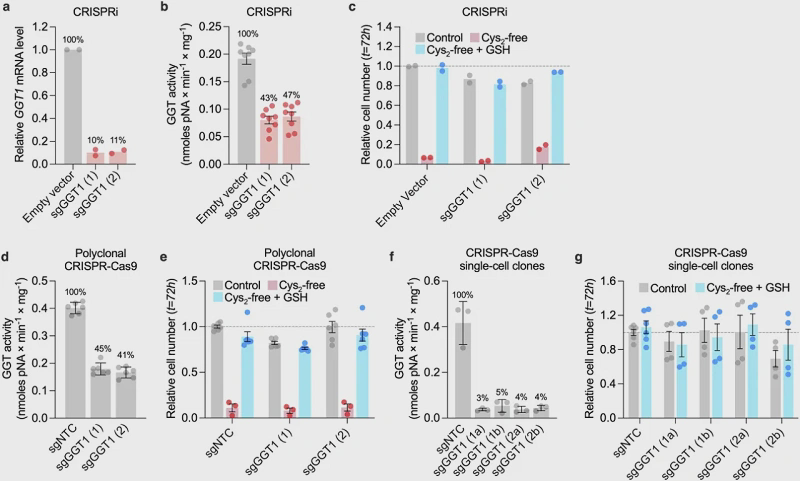
Considering that there are various enzymes with GGT activity, among which GGT1 is the subtype with the strongest catalytic activity, the authors systematically verified the role of GGT1 in mediating glutathione degradation metabolism and tumor cysteine supply from both the "necessity" and "sufficiency" perspectives.
At the level of necessity, the author employs three independent strategies to assess the function of GGT1:
The CRISPRi-mediated knockdown cell line of GGT1, although showing nearly complete depletion of GGT1 mRNA, still retains considerable GGT enzyme activity, and its growth in both cysteine-rich and cysteine-free + glutathione supplemented conditions is no different from that of the control cells.
The GGT1 knockout cell line based on CRISPR–Cas9 showed a significant decrease in GGT activity, especially in the monoclonal strain.
However, under the condition of no cysteine + glutathione, the growth of tumor cells was still effectively rescued.
Further analysis revealed that cancer cells simultaneously express multiple GGT subtypes, but none of these subtypes showed dependence in the whole-genome genetic screening.
Although GGT expression is higher in most tumor subtypes than in normal tissues, GGT genes rarely undergo mutations in tumors, and the expression of Ggt1 in mouse tumors is independent of the Gclc expression level and the tumor growth site.
These results suggest that GGT1 is not the sole enzyme that tumor cells rely on for utilizing glutathione; other members of the GGT family and unknown proteins with GGT activity may also have redundant functions.
At the sufficiency level, the author demonstrated through overexpression of GGT1 in cells that both the protein level and the enzymatic activity of GGT were significantly increased.
It is worth noting that the concentration of glutathione required for the growth of GGT1+ cells under cysteine-free conditions was significantly lower than that of the control cells, suggesting that the GGT-mediated glutathione breakdown is the rate-limiting step in the glutathione-dependent cell rescue process.
Based on this, the author hypothesizes that cells with high GGT activity can break down glutathione through paracrine signaling to support the growth of surrounding cells.
To verify this hypothesis, the author used the Transwell co-culture system to co-culture GGT1+ cells with wild-type (WT) cells.
The results showed that, under the condition where the glutathione concentration was lower than the threshold required to rescue WT cells, co-culture with GGT1+ cells could still completely restore the growth of WT cells.
The growth rate of GGT1+ cells in the absence of cystine and glutathione was significantly faster than that of WT cells.
However, this growth advantage was not observed in the presence of abundant cystine, and this growth advantage was also confirmed in the in vivo xenograft model.
The author demonstrated that the GGT activity is sufficient to drive the breakdown of extracellular glutathione and support the survival of surrounding cells under cystine deficiency conditions.
This further suggests that non-tumor tissues or cells with high GGT activity in the tumor microenvironment can decompose glutathione through paracrine mechanisms and supply amino acids, thereby promoting tumor growth and progression.
Glutathione catabolic metabolism alters drug sensitivity of tumors.
Given that the metabolic environment can significantly affect the sensitivity of cancer cells to anti-tumor drugs, the authors further investigated the changes in the drug sensitivity profile of tumors when they shift from relying on cysteine to relying on glutathione for obtaining cysteine.
To assess this transformation in an unbiased manner, the authors employed a multifunctional pharmacological screening strategy (MAPS) and conducted a systematic screening of a compound library containing 240 metabolic inhibitors (Figures 4A and 4B).
The results showed that when cancer cells switched to using glutathione as the source of cysteine, their sensitivity to the proposed inhibitor GGsTop for inhibiting GGT activity significantly increased (Figures 4B, C);
On the contrary, the cells showed significantly reduced sensitivity to cystine uptake inhibitors (such as erastin) and thioredoxin pathway inhibitors (such as auranofin, aurothioglucose and PX-12) (Figures 4B–D).
The latter pathway is responsible for the reduction process of cystine after its entry into the cell.
The author points out that the decline in sensitivity may result from multiple mechanisms:
On the one hand, extracellular glutathione may bind to these inhibitors and thereby deactivate them;
On the other hand, when cancer cells utilize glutathione as the source of cysteine, their dependence on the xCT and TXNRD1 pathways decreases accordingly.
This result also indicates that the presence of glutathione in the tumor microenvironment may undermine the feasibility of anti-tumor treatment strategies targeting the above pathways.
The author specifically pointed out that the concentration of cystine in commonly used cell culture media (such as DMEM, RPMI and F12) is far beyond the physiological level, yet these media lack glutathione and CysGly components.
This may have led to the overestimation of the contribution of xCT to cancer cell growth in previous studies, while underestimating the biological importance of the GGT family enzymes.
Glutathione catabolism supports tumor growth
Based on the differential sensitivity of the GGT inhibitor GGsTop observed in the aforementioned MAPS screening, the authors further verified it as a candidate therapeutic strategy targeting glutathione degradation and blocking the supply of cysteine to tumors.
The author compared the inhibitory activities of various GGT inhibitors (GGsTop, acivicin and OU749), and confirmed that GGsTop was the most effective GGT blocker.
Under conditions without cysteine and glutathione, cancer cells exhibited high sensitivity to GGsTop.
However, when the GGT catalytic product CysGly was added to the culture system, this sensitivity was completely reversed, confirming that the anti-tumor effect of GGsTop is indeed mediated by blocking the enzymatic hydrolysis step from glutathione to CysGly.
Based on the analysis of public datasets and the determination of GGT activity in mouse tissues, the authors confirmed that the kidney is the organ with the highest expression and activity of GGT1.
The dose optimization experiment demonstrated that a single intraperitoneal injection of GGsTop daily was insufficient to inhibit the GGT activity in the kidneys, but twice-daily administration could achieve a significant inhibition.
Further in vivo validation demonstrated that GGsTop treatment could effectively inhibit GGT activity and significantly delay tumor growth, without causing obvious systemic toxicity (Figures 5F–I).
At the mechanism level, after GGsTop treatment, the tGSH level in the mouse serum increased, while the cysteine level within the tumor decreased (Fig. 5J, K).
At the same time, the cysteine-dependent metabolite taurine decreased, and the eye acid, which is catalyzed to be generated by GCLC only when cysteine is deficient, significantly accumulated (Fig. 5L, M).
Correspondingly, the levels of glutathione, GSSG and glutamate within the tumor were not affected by GGsTop, indicating that this inhibitor specifically blocks the decomposition and utilization of GSH rather than its synthesis.
To further confirm that cysteine depletion is the direct mechanism underlying the anti-tumor effect of GGsTop, the authors conducted rescue experiments:
The cysteine source (NAC) that enhances membrane permeability can effectively reverse the tumor growth inhibition induced by GGsTop;
Although the combined treatment of NAC and GGsTop did not restore the total amount of cysteine in the tumor, it was able to restore the level of taurine and partially inhibit the accumulation of oxaloacetic acid.
The author confirmed that GGsTop remains stable in room temperature aqueous solutions.
Administering it by drinking water can also inhibit the GGT activity in animals and significantly suppress tumor growth.
The author demonstrated that the GGT activity is a crucial step in maintaining glutathione catabolism to supply cysteine to tumors.
Blocking GGT can cause tumors to enter a "cysteine starvation" state, thereby inhibiting their growth.
This provides a new and clinically transformative treatment strategy for cancer patients.
References:
Hecht F, Zocchi M, Tuttle ET, et al. Catabolism of extracellular glutathione supplies cysteine to support tumours. Nature. 2026;653(8115):933-941. doi:10.1038/s41586-026-10268-2