

Early identification and immediate medical attention │ Citicoline provides an extra layer of protection for stroke rehabilitation!
Health science popularization
Winter is a high-incidence season for stroke.
In the face of this seasonal risk, it is particularly important to enhance awareness of stroke prevention and master identification methods.
October 29, 2025 marks the 20th "World Stroke Day". This year, the World stroke Organization (WSO) has determined the global core slogan as: "Every Minute Counts. Know the signs of stroke. Act FAST."
In light of the actual situation in China, the Chinese Stroke Association has released the Chinese theme for World Stroke Day 2025: "Identify Early, Seek Medical Attention Immediately."
"Early identification" emphasizes that the public should be familiar with the typical symptoms of stroke and be able to detect abnormalities at the first moment.
"Seek medical Attention immediately" highlights the urgency of "time is brain, time is life", guiding the public to call the emergency number immediately after identifying a stroke and seek professional medical treatment [1].
Stroke is characterized by "five highs"
Stroke is an acute neurological deficit syndrome, which occurs due to cerebral vascular disease causing circulatory disorders in the brain.
It can be classified into ischemic stroke (cerebral infarction) and hemorrhagic stroke (cerebral hemorrhage, subarachnoid hemorrhage, etc.), and is characterized by five major features: high incidence, high recurrence rate, high disability rate, high mortality rate, and high economic burden [2].
The World Stroke Organization: Global Stroke Facts Report 2025 [3] shows that:
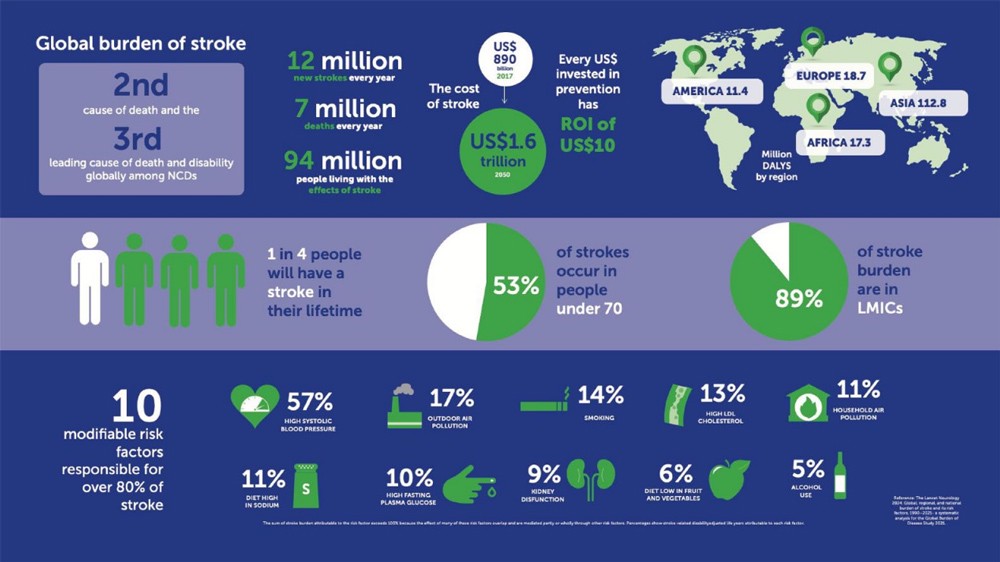
Among non-communicable diseases, stroke remains the second leading cause of death worldwide (about 7 million people) and the third leading cause of death and disability (measured by disability-adjusted life years (DALYs) - global DALYs loss exceeds 160 million).
Between 1990 and 2021, the number of global stroke cases, deaths and disabilities rose significantly, with the incidence rate increasing by 70%, the mortality rate by 44%, and the loss of DALYs by 32%.
It is estimated that stroke causes over 890 billion US dollars in economic losses globally each year, and this figure is expected to nearly double by 2050 (Figure 1).
It is particularly important to identify it as early as possible and seek medical attention immediately
After a stroke occurs, approximately 1.9 million brain cells die every minute.
The earlier the treatment, the less brain damage and the greater the hope of recovery [1].
Therefore, it is particularly important to identify a stroke as early as possible and seek medical attention immediately.
Acute ischemic stroke is a common type of stroke, accounting for 69.6% to 72.8% of new strokes in China [4].
Ischemic stroke usually has a sudden onset.
It is often accompanied by risk factors and causes of vascular diseases;
Fatigue, diarrhea, cold and staying up late are common triggers for ischemic stroke.
Dizziness, headache and other symptoms are common precursors of ischemic stroke, and they can also be asymptomatic or have no precursors at all [5].
When the disease occurs, patients may experience symptoms such as coma, incoherent speech and cognitive dysfunction (confusion), double vision, crooked mouth corners, choking when drinking water, limb weakness, unsteady gait, and numbness in the face and/or limbs [5].
A variety of stroke recognition tools have been developed outside China, such as "BEFAST" and the "Stroke 120" mnemonic.
When any suspected symptoms of stroke occur, do not hesitate or wait for the symptoms to disappear on their own. Immediately call emergency numbers such as 120/999.
Ambulances can provide pre-hospital emergency care and directly transport the patient to a "stroke center" with the ability to treat stroke [1].
Neuroprotective therapy is an important adjuvant treatment method for stroke
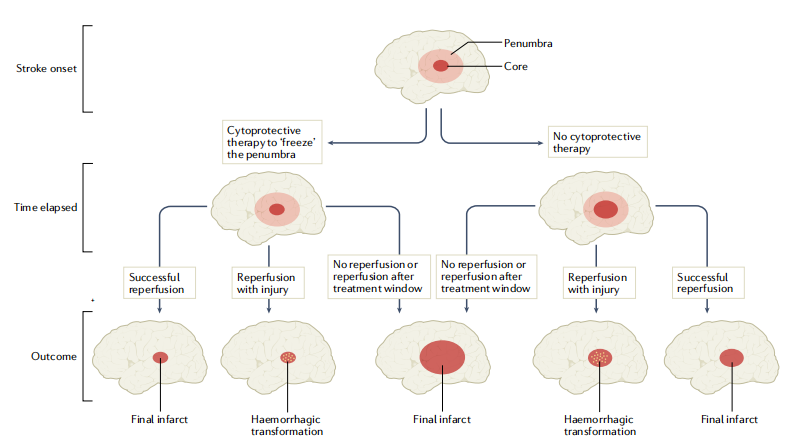
The core of the treatment for acute ischemic stroke is to save the brain tissue in the ischemic penumbra.
Early vascular recanalization (including intravenous thrombolysis and endovascular treatment) can restore blood perfusion to ischemic tissues and is currently an effective treatment method confirmed by evidence-based medicine [6].
However, although thrombolysis and endovascular interventional therapy can significantly improve the functional outcomes of patients, their clinical application is limited by time window constraints and the risk of hemorrhagic transformation, etc. [7]
Initiating neuroprotective treatment as early as possible helps "freeze" the penumbra tissue, thereby preventing the further expansion of the infarction core area before the completion of reinfusion treatment (Figure 3) [8].
It is very important to use neuroprotectants alone or in combination as soon as possible after a stroke to reduce nerve damage.
Neuroprotectants refer to any agents that intervene in ischemic brain injury by antagonizing harmful molecules in the cascade reaction of ischemic brain injury in a way that does not improve cerebral blood perfusion [9].
Neuroprotectants are classified into calcium channel blockers, glutamate receptor antagonists, gamma-aminobutyric acid (GABA) receptor agonists, free radical scavengers, nitric oxide mediators, cell membrane stabilizers, mitochondrial protectants, and other types based on the different stages of the ischemic cascade reaction they act on [10].
Citicoline is one of the commonly used neuroprotective agents in clinical practice and is widely used in the treatment of neurological diseases such as traumatic brain injury, acute ischemic stroke, cognitive impairment, Parkinson's disease and Alzheimer's disease.
Citicoline is an important precursor of phosphatidylcholine, the main component of cell membranes. It participates in the formation of the phospholipid bilayer of cell membranes and plays a significant role in stabilizing cell compartmentalization, stimulating the repair and regeneration of damaged neuronal cell membranes, etc.
Therefore, it can be classified as a cell membrane stabilizer.
Citicoline is also a precursor of acetylcholine and can increase the levels of neurotransmitters [10-11].
treatment with citicoline after stroke is beneficial for functional recovery and improvement of cognitive function
A meta-analysis [12] showed that oral administration of citicoline within 24 hours after the onset of moderate to severe stroke could increase the possibility of complete recovery three months later.
This meta-analysis included four prospective, randomized, placebo-controlled, double-blind, oral citicoline studies, involving a total of 1,372 patients with acute ischemic stroke (National Institutes of Health Stroke Scale [NIHSS] score ≥8 and previously modified Rankin Scale score ≤1), among whom 583 patients received placebo treatment. A total of 789 patients received citicoline treatment.
The results showed that after 3 months of treatment, the recovery rate of patients in the citicoline group was 25.2%, while that in the placebo group was 20.2% (odds ratio [OR]=1.33, 95% confidence interval [CI]=1.10-1.62, P=0.0034).
The overall safety of citicoline was good and similar to that of the placebo.
An open-label, randomized, parallel controlled study [13] demonstrated that long-term use of citicoline treatment could significantly improve the quality of life and cognitive function of patients with their first ischemic stroke two years later.
A total of 163 patients with their first ischemic stroke were included in this study.
They were randomly assigned to the citicoline group and the conventional treatment group 6 weeks after the onset of the disease.
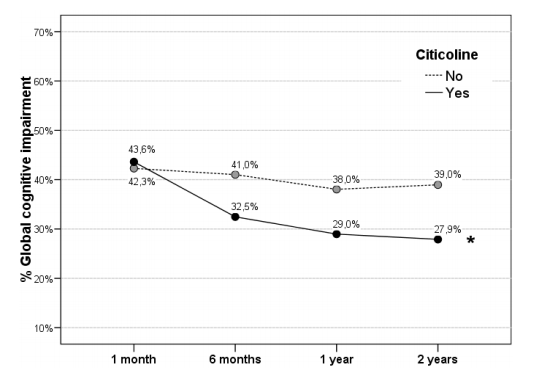
Neuropsychological evaluations were conducted at 1 month, 6 months, 1 year and 2 years after stroke, respectively.
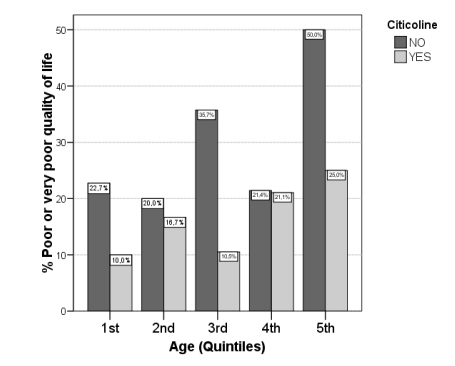
At 2 years, the European Five-Dimensional Health Scale (EuroQoL-5D) used to assess the quality of life.
The results showed that citicoline treatment significantly improved cognitive status during the follow-up period (P=0.005) (Figure 6).
After adjusting for age, non-use of citicoline associated with a poorer quality of life.
Citicoline treatment associated with a better quality of life for both older people and young patients (Figure 7).
The global burden of stroke continues to increase, and the situation of prevention and treatment is severe.
Early identification and timely treatment are the keys to improving the prognosis of stroke.
Mastering identification tools such as "BEFAST" and "Stroke 120",
promptly calling for emergency assistance and sending the patient to a stroke center is of vital importance.
In terms of treatment, apart from vascular recanalization therapy, neuroprotective therapy,
as an important auxiliary measure, can "freeze" the ischemic penumbra before reperfusion, thereby reducing nerve damage.
Citicoline, as a commonly used neuroprotective agent, has shown positive effects in promoting functional rehabilitation and cognitive improvement after stroke in multiple studies through various functions such as stabilizing cell membranes, stimulating the repair and regeneration of damaged neuronal cell membranes, and increasing the levels of neurotransmitters, with good safety.
The prevention and treatment of stroke require "early identification, prompt medical treatment and comprehensive treatment".
The application of neuroprotective agents such as citicoline can provide more guarantees for patients' recovery.
References
- The stroke association in China. https://www.chinastroke.net/a810.html
- The Writing Group of the "China Stroke Center Report 2022". Chinese Journal of Cerebrovascular Diseases, 24,21(08):565-576.
- Su Xuan. Chinese Journal of Medical Sciences,2014(19):5-8.
- Neurology Branch of Chinese Medical Association, etc. Chinese Journal of Neurology,2024,57(6):523-559.
- Chinese Medical Association, etc. Chinese Journal of General Practitioners,2021,20(9):947-958.
- Lu Dan, et al Chinese Journal of Stroke, 24,19(08):938-955.
- Zhang Ying, et al. Nerve Injury and functional Reconstruction,2021,16(05):266-269.
- Fisher M,et al.Nat Rev Neurol.2022 Apr; 18 (4) : 193-202.
- Gu Yawei, et al. Chinese Journal of Neurology,2024,23(03):291-295.
- Xiao Weimin, et al. Internal Medicine Theory and Practice,2019,14(05):282-288.
- Tang Yaqian, et al. Journal of Biological Engineering,2024,40(06):1644-1660.
- Davalos A,et al. Stroke-2002 Dec; 33 (12) : 2850-7.
- Alvarez-Sabin J,et al.Int J Mol Sci.2016 Mar 16; 17 (3) : 390.